
The Practice You Actually Wanted Is Still Available
From Clinician to Owner: The Healthcare Practice Owner's Field Guide

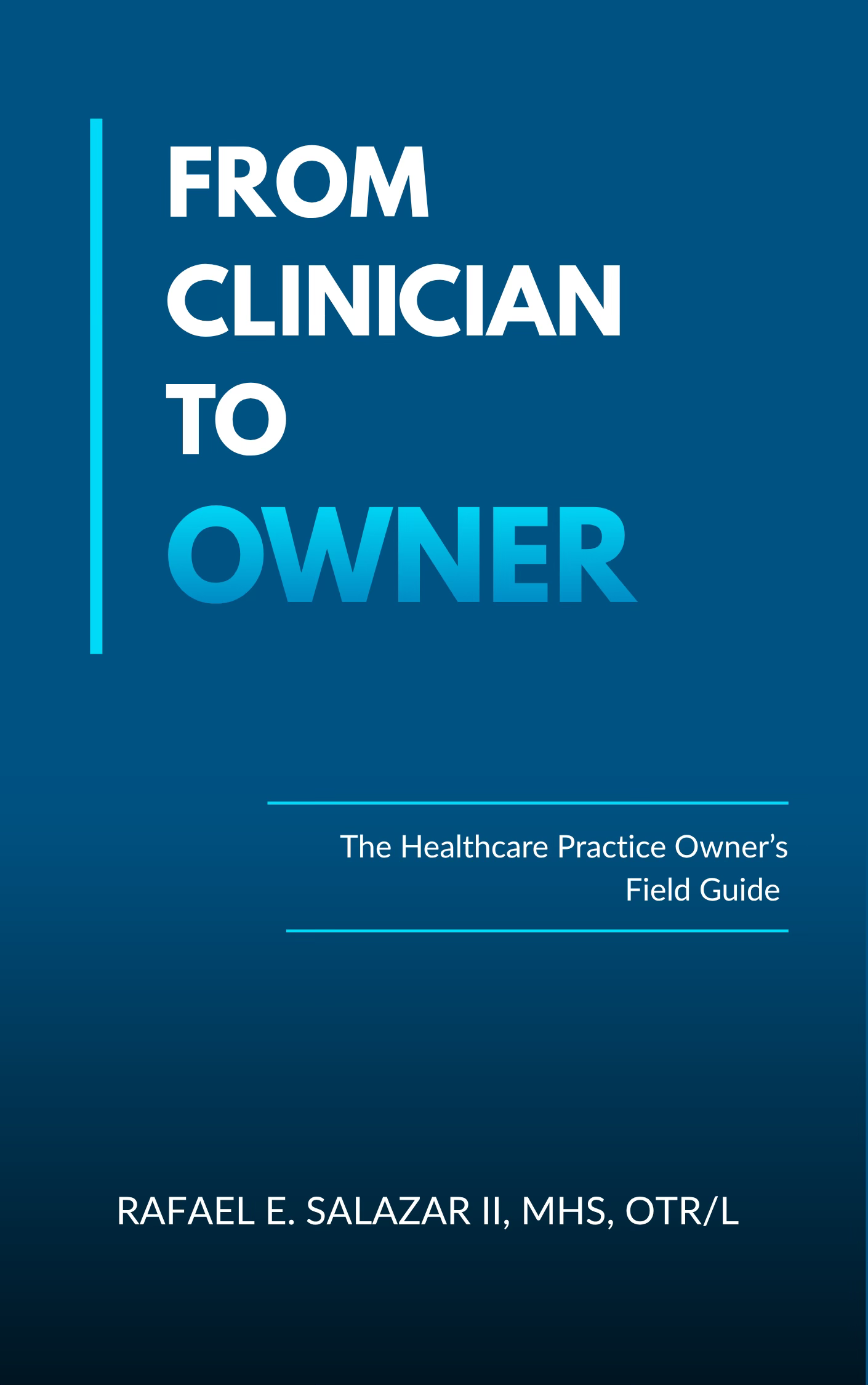
There’s a moment most practice owners remember clearly.
It’s usually somewhere in the first year or two. The schedule is full. The team is mostly working. The billing is going out. And somewhere in the middle of a Tuesday afternoon — buried in a payer denial, or covering for a clinician who called out, or staring at a bank account that doesn’t reflect the month you just had — a quiet question surfaces:
Is this actually what I built this for?
That question is the reason I wrote this book.
What Nobody Tells You Before You Sign
Most clinicians who become practice owners make the same fundamental mistake. Not a financial mistake. Not an operational one. A thinking mistake.
They go from being a clinician — deeply trained in assessment, precision, patient-centered reasoning — to running a business, and they never actually make the shift. They bring the clinical brain to the owner job and wonder why it doesn’t fit.
The clinical brain is built for right answers. Business runs on tradeoffs. The clinical brain is trained to gather more information before acting. Business rewards the good-enough decision made now over the perfect decision made too late. The clinical brain is oriented toward the patient in front of you. The owner brain has to hold the patient, the team, the payer relationship, the cash flow, and the five-year picture simultaneously.
That gap — between how clinicians are trained to think and how owners need to think — is where most practices get stuck. Not because the clinician isn’t smart enough. Because nobody ever named the gap, let alone showed them how to close it.
From Clinician to Owner is the book that closes the gap.
My Unlikely Path Into Practice Ownership
I should tell you something upfront: I’m not a physical therapist.
I’m an occupational therapist. And in October of 2020 — during a pandemic, with a business model that had been losing ground for years — I bought an outpatient physical therapy practice.
By most conventional measures, this made no sense. I wasn’t a PT. I hadn’t been in direct clinical work for years. The practice I was acquiring had declining revenue, a demoralized team, and a valuation that reflected all of the above.
What I had was a clear head about what the numbers actually said, a framework for what good operations looked like, and — critically — the constraint of not being able to fall back on being the clinician. Because I couldn’t fill the schedule myself, I had to build systems from day one. Because I wasn’t the clinical expert in the room, I had to hire people who were and then build an environment that kept them.
That constraint turned out to be a gift.
Within a few years, we had grown from roughly 125 visits a month to around 500. We built documented operating systems that allowed the practice to run without my daily presence. We developed a competitive position that took years and the right relationships to establish. And we attracted serious acquisition interest from multiple buyers — including private equity firms who got genuinely excited about how the business was structured.
None of that happened because I was exceptionally talented. It happened because I was applying, deliberately and consistently, a set of principles that most practice owners either don’t know or don’t prioritize.
Those principles are what this book is about.
What’s Inside
From Clinician to Owner is organized into six parts that cover the complete arc of practice ownership — from the mindset shift that has to happen before anything else works, to the financial mechanics of what your practice is actually worth when it’s time to exit.
Part One: The Owner’s Mind
The book starts where most practice ownership books don’t: with how you think, not what you do. The operator-owner-investor framework gives you a precise, honest way to assess where you actually are — not where you’d like to be — and a clear map of what it takes to move up. The exit conversation happens here too, early and deliberately, because knowing where you’re going changes every decision you make about how to build.
Part Two: Getting In
An honest comparison of buying versus building — including the real downsides of each path that most people gloss over. If you’re buying, there’s a chapter on finding, evaluating, and closing a deal that covers what due diligence actually looks like and where first-time buyers consistently get burned. If you’re building, there’s a chapter on the little bets framework and how to start without betting the farm. Either way, there’s a chapter on financing that treats money like the adult topic it is.
Part Three: Building the Machine
This is the unglamorous section. The one most clinicians skip in favor of more interesting topics. Also the one that determines whether the practice is worth anything to anyone — including you. The operations manual nobody told you to build. Cash flow management using the Profit First framework, adapted for healthcare realities. Payer relationships and how to play defense in a system that was not designed with your interests in mind. And the financial metrics that actually tell you what’s happening in the practice before it’s too late to respond.
Part Four: People
The three-stage hiring process that filters for culture before it filters for credentials. A compensation philosophy built on knowing your numbers before the negotiation starts. And the hardest chapter in the book — how to keep the people worth keeping, and how to let go of the people who need to go, in both cases with the honesty and care that the relationship deserves.
Part Five: Growing with Purpose
Positioning: the single strategic decision that most small practices either avoid or get wrong, and why getting it right changes everything downstream. Marketing reframed as the distribution of expertise rather than the production of content — which makes it both more sustainable and more effective. And technology assessed through a single lens: is this a force multiplier, or is it a subscription I’m not really using?
Part Six: Knowing Your Number
How to use acquisition conversations as free consulting — even when you’re not ready to sell. The three types of buyers (internal successor, strategic acquirer, private equity), what each one actually values, and how to build toward the exit that fits your goals. The valuation mechanics that determine what your practice is actually worth, including the multiple ranges for well-run single-location practices in the current market and the deal terms that determine what you actually walk away with. And the first million — why liquid net worth is the most transformative financial milestone an entrepreneur reaches, and a simple framework for building toward it deliberately.
Who This Book Is For
This book was written for three different readers.
If you’re a clinician considering ownership — thinking about buying a practice, starting one, or taking over from a partner — this book is the preparation nobody offered you in clinical school. Read it before you sign anything.
If you’re already an owner who is stuck — busy but not thriving, working hard but not building toward anything, wondering why the freedom you imagined hasn’t materialized — this book is the framework for getting unstuck. The gaps in most practices are operational, not fundamental. They’re fixable. This book shows you how.
If you’re an owner who has built something good — and you’re starting to think about what comes next, what the practice is worth, what a great exit looks like — this book is your guide to the last chapter of the ownership journey. The one where the work you’ve done gets recognized in financial terms, and the life you built the practice for becomes fully available.
A Note on Why I Wrote This
I’ve been asked, more than once, why I decided to write a book about practice ownership when I could be spending that time on consulting or content that is more directly connected to the practice itself.
The honest answer is that I kept having the same conversation.
A clinician would reach out — through the podcast, through a consulting inquiry, through a mutual connection — and the conversation would follow the same arc. They were thinking about ownership, or they were in the middle of it and struggling, or they had built something good and weren’t sure what to do with it. And in every case, the gaps they were dealing with were the same gaps. The same mindset challenges. The same operational blind spots. The same financial confusion around valuation and exit.
I was giving the same advice, one conversation at a time, when I could have written it down once and made it available to everyone who needed it.
So I did.
The result is the book I wish I’d had when I signed the purchase agreement for our practice in October of 2020. Not because it would have made everything easy — it wouldn’t have. But because it would have named the challenges clearly enough that I could have addressed them deliberately rather than discovering them the expensive way.
What a Good Thursday Looks Like
I want to close with the image that opens the book, because I think it’s the most honest summary of what this is all about.
It’s a Friday morning as I write this. At noon I’m cutting out to catch a jiu-jitsu class before heading home for the weekend. Tonight is family movie night. I won’t check my work email until Monday.
Yesterday — Thursday — I picked up my kids at 1:45. We homeschool, so they were home. I took them to their jiu-jitsu class, then came home and helped my wife get dinner prepped. Most days I go home for lunch. The afternoons are for the podcast, the Substack, the consulting work, the book.
The clinic is running. The team is doing what the team does. Nobody called me.
That is not a boast. It is a description of what deliberate practice building actually produces — a business that works for you rather than one you work yourself into the ground for.
That outcome is available to you. Not my specific version of it — yours will look different, and it should. But the underlying thing: the practice that runs, that generates wealth, that serves its community, and that supports the life you actually want to live.
From Clinician to Owner is the field guide for building it.
Get the book here.